 Omer Schneider
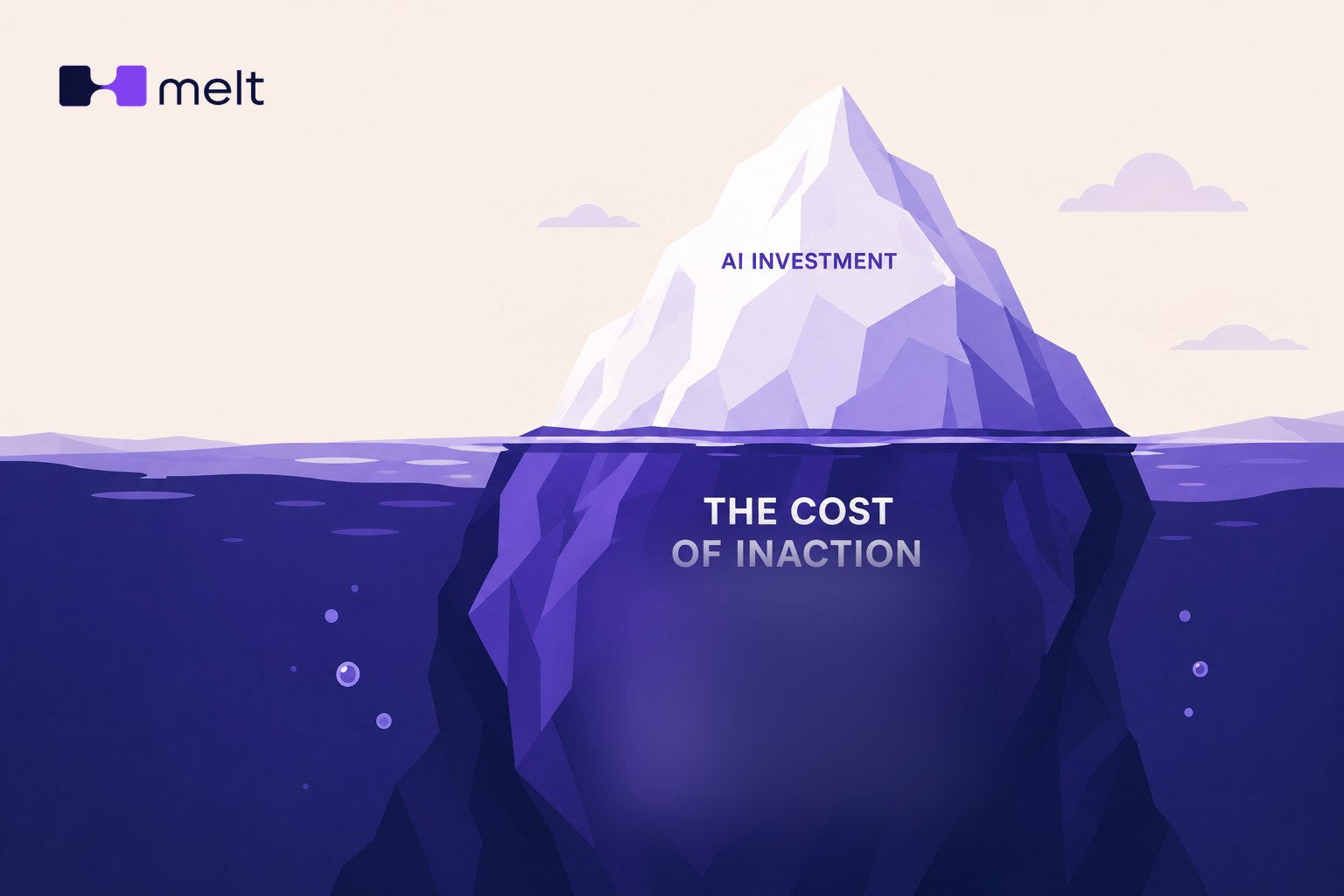
Every AI budget conversation starts with the same question: what's this going to cost us? That's the wrong question, or at least an incomplete one. The number that should worry a CFO isn't the license fee or the implementation cost. It's the number that never makes it onto a slide, because it never shows up as a line item: the cost of inaction, what you lose every month you keep running the old way while everyone at the table debates whether the new way is worth it.
Most companies don't skip AI. They pilot it: buy a few seats, run a workshop, stand up one flashy use case for a board meeting. Then it stalls, not from a lack of ambition but because nobody can say with a straight face whether it's working. MIT's 2025 review of enterprise AI deployments found 95% of pilots showed no measurable P&L impact despite $30-40B in enterprise investment. The org ends up in a holding pattern, not committed enough to scale it, not honest enough to kill it. That holding pattern has a price. It's just invisible.
Cost of inaction isn't a scare tactic. It's a category.
It's tempting to file "cost of inaction" under vendor fear-mongering, the phrase that shows up right before a budget request. That skepticism is fair. But there's a real, decomposable thing underneath it, and it lives in three places.
Hidden manual waste. Work your teams still do by hand that tools already in your stack could do faster, except nobody mapped the workflow to the tool. This is rarely a technology gap. It's a mapping gap.
Dormant software. Capability you already paid for, sitting in a contract your team logs into every day, unused not because it doesn't work but because rollout stopped at "we bought it" and never reached "we use it." Procurement closed the ticket the day the contract was signed. Operationally, nothing started. A 2025 audit of enterprise software portfolios found the same pattern at scale: 66% of licensed applications sit idle or underused, wasting an average of $19.8M a year.
Fragmented deployment. Three departments running their own AI pilot, in isolation, with no shared way to measure results. Nobody can compare them, so nobody can decide which to fund and which to kill. The org ends up maintaining a portfolio of experiments instead of a strategy, because killing any one of them means an argument nobody wants to have without data.
Each of these compounds. A workflow that stays manual this quarter costs the same wasted hours next quarter. A dormant module doesn't fix itself. Usage habits calcify around the workaround, and by month six "we'll get around to enabling it" has quietly become "nobody remembers why we bought it."
Why it never shows up on the P&L
This cost is real, and it will never trigger a budget conversation on its own, because accounting isn't built to catch foregone value. Finance can flag an expense that runs too high. There's no equivalent alert for "we should have saved $400K this quarter and didn't." Nothing breaks, nothing goes over budget, so nobody has to explain it.
Ask ten operations leaders if their teams are more efficient than eighteen months ago, and most will hedge. Ask them to put a number on the gap between where they are and where they could be, and the room goes quiet. Not because the number is small. Because nobody's measured it. BCG's 2025 research found only 22% of companies have moved past proof-of-concept to generate real AI value, and just 4% are seeing it at scale.
A rough way to estimate it yourself
You don't need a platform for a first pass, just honesty about where the waste is. Pick one workflow you suspect is manual busywork AI could touch, report assembly, ticket triage, first-pass document review, and run the math:
Hours on the task per week, per person × people doing it × fully loaded hourly cost × 52 weeks
That's the annual cost of the task as it stands. Now estimate what share of it a competent AI workflow could remove. Forty to sixty percent is a defensible range for repetitive knowledge work. Do this for three or four workflows across different teams and the total tends to surprise people, mostly because nobody had added it up before.
That's a gut check, not a system. It tells you whether the number is worth caring about, not where exactly the value sits or whether it's moving month over month. For that, you need one baseline you track over time, not three spreadsheets that don't talk to each other. That's what Melt Score is for: a single 0-100 baseline of where an organization is creating value, losing it, or never capturing it in the first place, so the conversation moves from "is this a problem" to "what do we fix first."
"But we already track our AI spend"
This comes up almost every time. Tracking spend tells you what you committed. It tells you nothing about what you got back. A company can have immaculate records of every license purchased this year and still have no idea whether any of it changed how work gets done. Spend is an input metric. Cost of inaction is about the output you're not getting, and usually nobody owns that measurement.
Same with "our teams say they're using it." Self-reported usage is a survey answer, not a result. People tend to believe they're using new tools more than they are, and even when they are, "used it" and "changed the outcome" aren't the same claim.
Where to go from here
If you've read this far, you probably already suspect the number is bigger than your organization has admitted out loud. That instinct is usually right. The fix isn't a bigger AI budget. It's an honest baseline of where the value actually is and isn't, so the next dollar moves the number instead of adding another pilot to the pile.
Frequently asked questions
What is the cost of inaction on AI investment?
It's what an organization loses every month it keeps running the old way while debating whether an AI investment is worth it. It usually lives in three places: hidden manual waste (work that could be automated but isn't because nobody mapped the workflow to the tool), dormant software (AI capability already paid for but never rolled out past "we bought it"), and fragmented deployment (isolated pilots across departments with no shared way to measure results).
Why doesn't the cost of inaction show up on the P&L?
Because accounting is built to catch overspending, not foregone value. Finance can flag an expense that runs too high, but there's no equivalent alert for value that should have been captured and wasn't. Nothing breaks and nothing goes over budget, so nobody has to explain it.
How can I estimate my own cost of inaction?
Pick one manual workflow AI could touch, then multiply hours spent on it per week per person, by the number of people doing it, by the fully loaded hourly cost, by 52 weeks. That gives the annual cost of the task today. Forty to sixty percent is a defensible estimate of how much a competent AI workflow could remove from repetitive knowledge work, which gives a rough annual cost of inaction for that one workflow.
Isn't tracking AI spend enough to know if it's working?
No. Tracking spend tells you what you committed, not what you got back. A company can have complete records of every AI license purchased and still have no idea whether any of it changed how work actually gets done. Spend is an input metric; cost of inaction is about the output you're not getting.