 Michal Gil
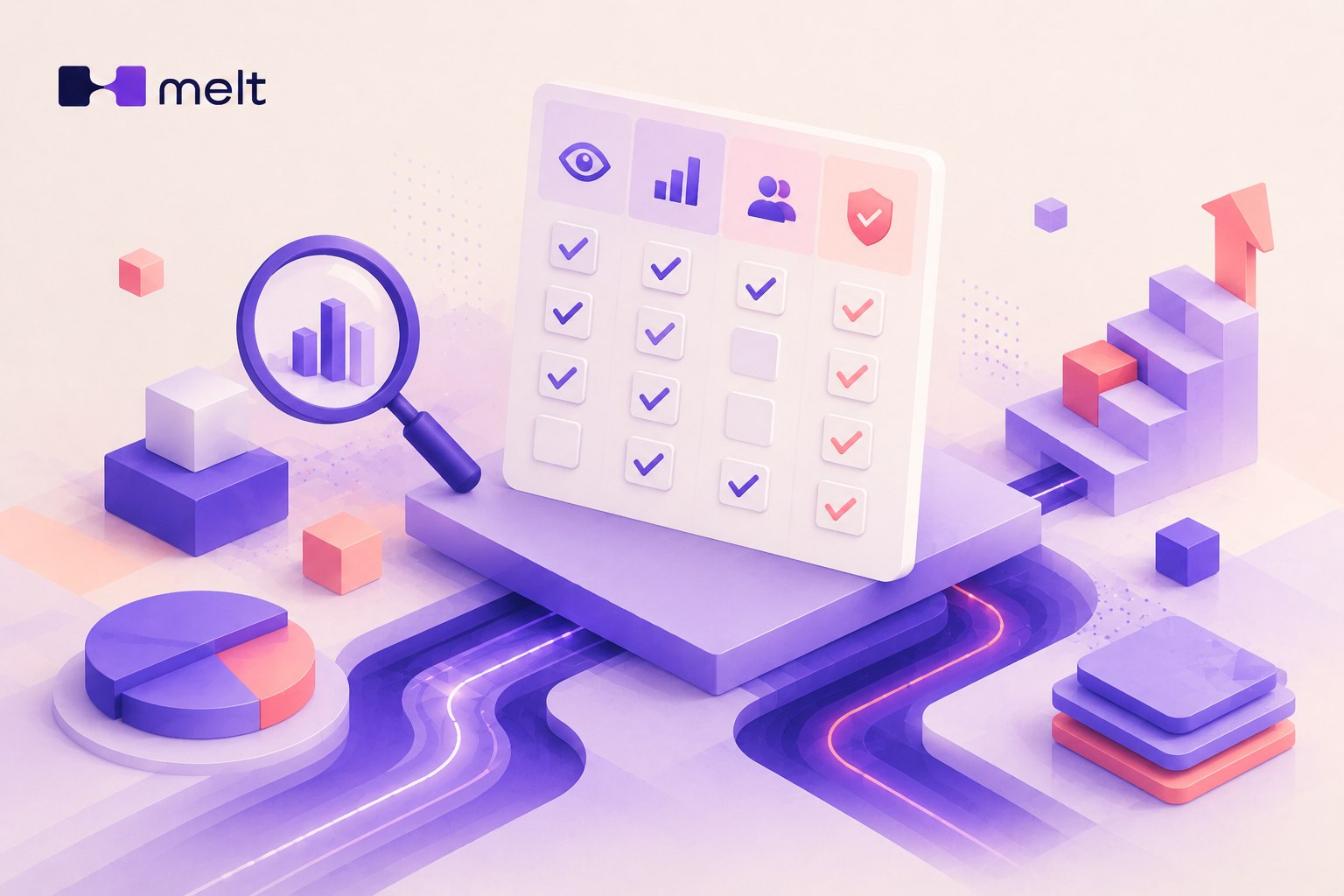
Most AI value conversations start with a hunch and end in a debate about whose hunch is right. A faster, more honest starting point is a scorecard everyone in the room fills out the same way. Score each item below 0 to 2: 0 if it's not true at all, 1 if it's partially true, 2 if it's fully in place.
Visibility
- We know the activation rate of every AI tool on our budget, not just whether it's "in use."
- We can see, per department, what percentage of a workflow AI actually touches versus what still happens manually around it.
Measurement
- Every AI initiative in our organization is measured against the same standard, not each against its own vendor's dashboard.
- We can trace a dollar figure back to a specific source-system log, not just an estimate or a survey.
Coordination
- A new AI initiative in one department can reuse what we learned from a previous one, rather than starting from zero.
- We have a shared, ranked list of where AI would create the most value across the whole organization, not just within one team's view of its own priorities.
Proof
- The last AI ROI number we presented to leadership was tied to a real number in a real system, not a sentiment or a projection.
- We are confident enough in our AI value data to put it in front of the board without caveats.
A late-2025 survey found 92% of CFOs and senior finance leaders feel pressure to prove AI is paying off, which is exactly the pressure this category is built to survive. A number you're confident enough to put in front of the board without a caveat is a different thing than a number you merely believe.
What your score actually means
| Score | Stage | What it means |
|---|---|---|
| 0-4 | Ad Hoc or Early Emerging | Start with visibility. You cannot fix a leak you cannot see. |
| 5-9 | Emerging or Scaling | Real progress but real gaps. Fragmented deployment across departments is probably your biggest constraint. |
| 10-14 | Approaching Embedded | The remaining work is usually proving ROI, closing the last mile between "we can see it" and "the board trusts the number." |
| 15-16 | Embedded | You're in a small minority. The next constraint is keeping the measurement layer live as new initiatives launch, not building it in the first place. |
Where to go from here
A score under 10 usually means the real constraint isn't ambition, it's visibility. You can't prioritize, measure, or prove the value of a leak you haven't found yet, which makes visibility the honest place to start regardless of which department you run.
Frequently asked questions
How is this self-assessment scored?
Score each of the eight statements 0 to 2 (0 = not at all, 1 = partially, 2 = fully in place), across four categories: Visibility, Measurement, Coordination, and Proof. Add them up for a score out of 16.
What does a low score, under 5, usually mean?
It usually means the constraint is visibility, not ambition. You can't fix, prioritize, or prove the value of a leak you can't see, so that's the honest place to start.
What does a high score, 15 to 16, actually get you?
A small minority position. Most organizations don't get there. The remaining work at that point isn't building the measurement layer, it's keeping it live and accurate as new AI initiatives launch.